Realistic Galaxy Design Begins With Distance
A galaxy theme can quickly become flat when it is treated as a pattern of stars pasted onto surfaces. Realism comes from distance, layering, light behavior, shadow, and restraint. The room or project should feel as if the eye can move through it: from a dark foreground to a glowing middle layer, then into a deeper background. When depth and glow are planned together, the design can feel cinematic and believable without needing constant planets, rockets, or novelty decor.
A: Layered darkness, believable light sources, touchable texture, and edited celestial details.
A: No, one strong wall, artwork, or lighting feature can create enough atmosphere.
A: Yes, if materials and furniture look intentional without special effects.
A: Using the same star pattern or glow on every surface.
A: Hide the source, dim the level, and use it to guide attention.
A: Not if they are used as sculptural forms and kept limited.
A: Midnight navy is often easier to live with than pure black.
A: No, they should appear only where they catch useful light.
A: Use a dark focal wall, layered lamps, and fewer larger details.
A: Remove objects that flatten the depth or repeat the same symbol.
Think in Layers, Not Decorations
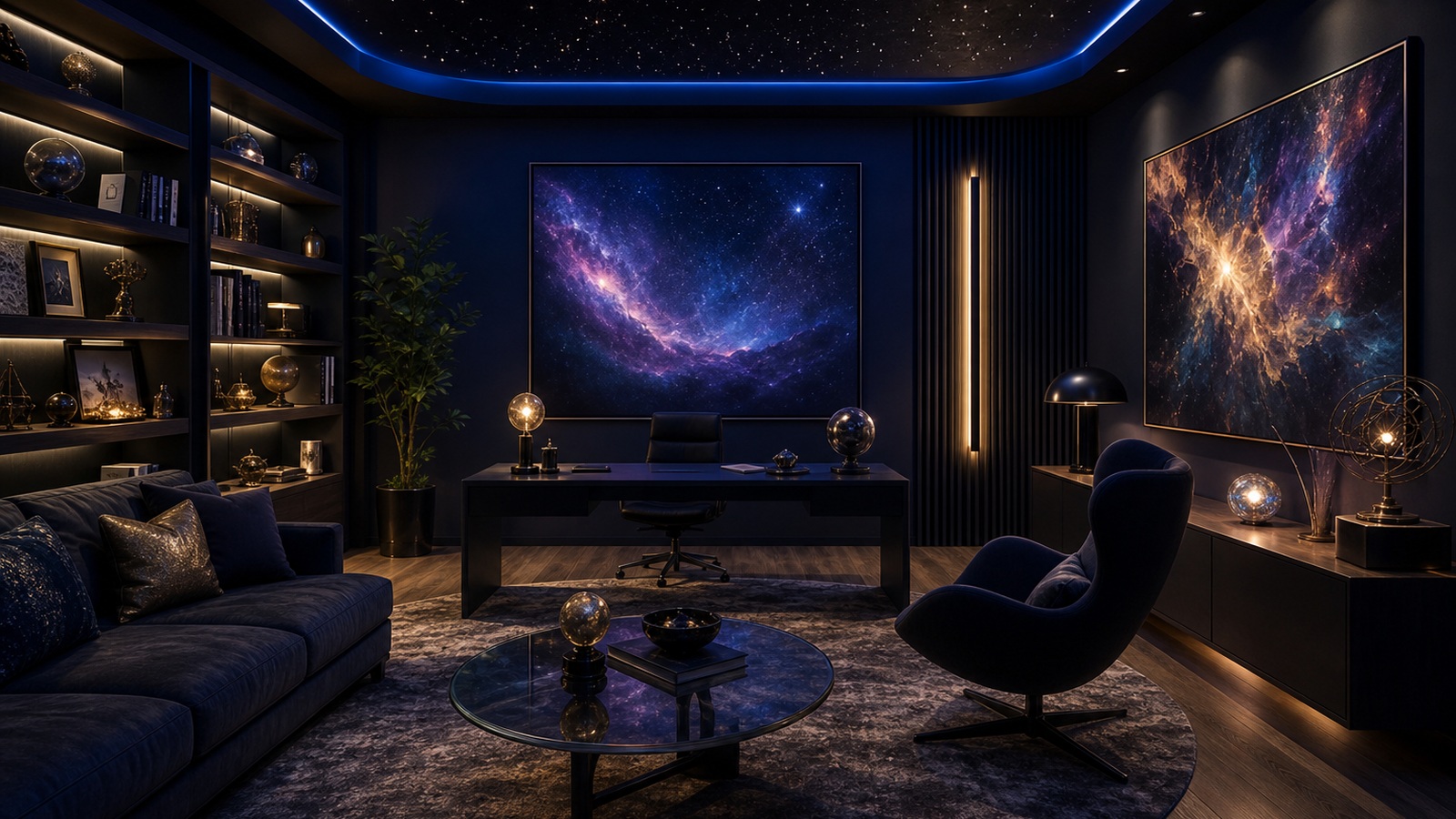
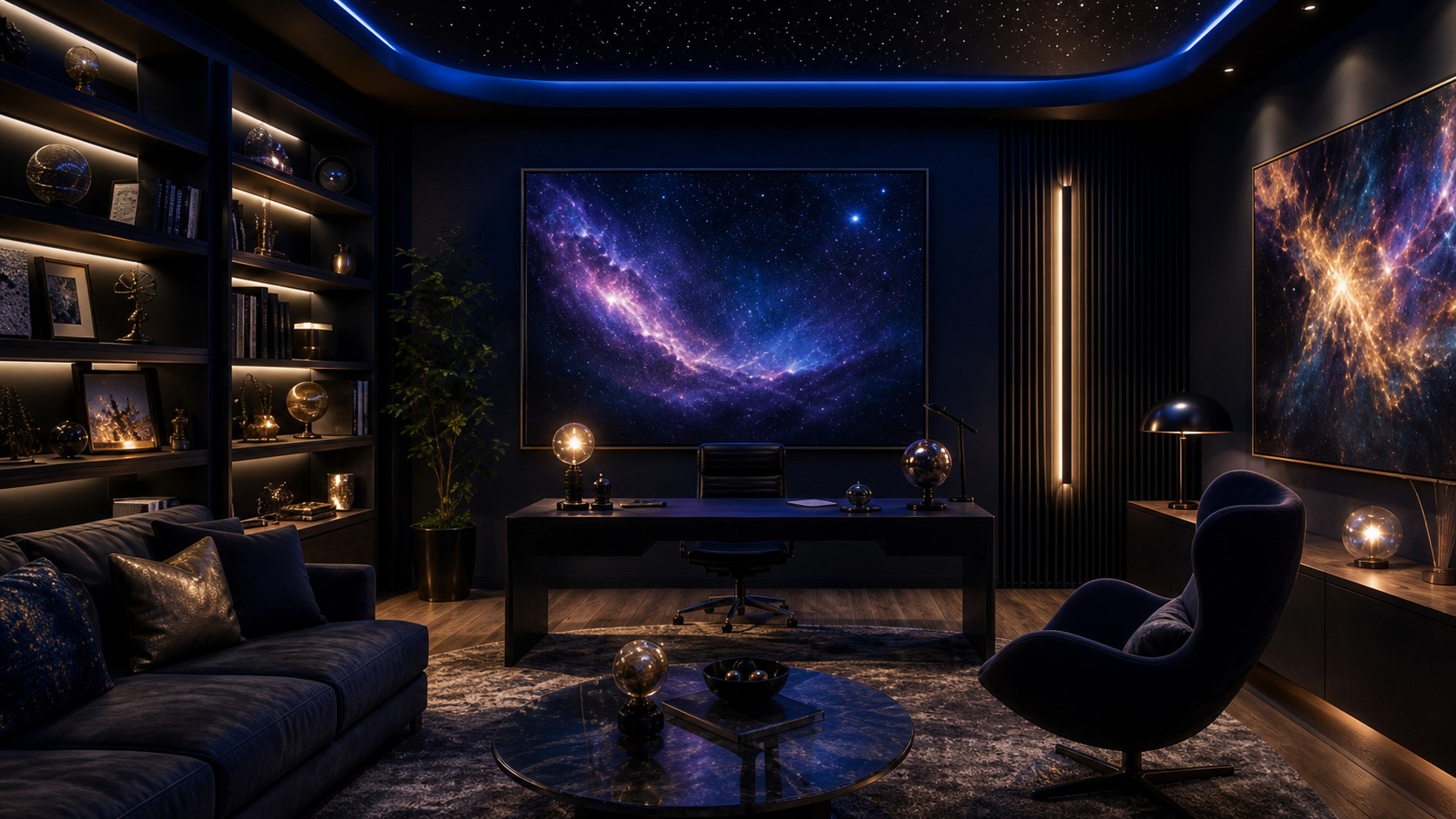
Depth begins with layers. A galaxy room might have a dark wall, a velvet chair in the foreground, a glass table catching a lamp, a glowing shelf, and a nebula artwork set farther back. A themed event might use a dim entry, a brighter central feature, and smaller points of light that continue into the distance. The theme becomes more realistic when the eye can travel.
Flatness happens when every surface has the same star pattern or the same blue-purple glow. Real space is not evenly decorated. It has emptiness, darkness, bright points, and distant clouds of color. A good design borrows that rhythm by creating contrast between quiet zones and active zones.
Before choosing objects, sketch the room or project as three zones: what is close, what is mid-distance, and what sits in the background. This simple map prevents every decorative decision from landing on the same visual plane. It also shows where darkness should remain untouched.
Control the Dark Base
Dark color is useful because it gives light something to react against. Midnight navy, charcoal, blackened teal, aubergine, and soft black can all create a deep field. The choice depends on the room and the mood. Navy feels classic, charcoal feels mature, violet feels dreamy, and black feels dramatic when balanced with texture.
The dark base should not erase every detail. Matte paint, ribbed panels, dark wood, or textured wallpaper can keep a wall from becoming a blank void. In a small room, dark color can still work if the lighting is layered and furniture is comfortable. In a larger room, it can make a feature zone feel more intimate.
Avoid choosing dark surfaces only for drama. Ask how the room will be cleaned, how dust will show, and how people will use it during the day. Realism includes maintenance. A galaxy design that only works for a few minutes at night will feel less successful over time.
Undertones deserve special attention. A navy with too much green may feel coastal, while a black with too much purple may become theatrical faster than intended. Sampling dark colors on the actual wall is essential because shadows and lamps change them dramatically.
Make Glow Behave Like Light
Glow should have a source and a reason. A backlit shelf, a concealed cove, a shaded orb lamp, or a cluster of tiny pin lights can all feel believable because the light appears to come from somewhere. Random glowing strips around every edge can feel artificial, especially when the wiring or controllers are visible.
Use different scales of light. Tiny points can suggest stars, soft washes can suggest distant nebulae, and larger lamps can act like moons or planets. The variation is what creates depth. One type of light repeated everywhere usually feels decorative rather than atmospheric.
Color temperature matters. Constant saturated blue or purple can become tiring. Warm white, soft amber, and dimmable neutral light make the room usable, while colored glow can appear in smaller accents. The more the room is used daily, the more practical light it needs.
Use Reflection Carefully
Reflective materials can make a galaxy theme feel deeper because they catch small points of light. Smoked glass, polished stone, chrome, brass, mirror, glossy ceramic, and metallic thread can all support the effect. They should be placed where they reflect something intentional.
Too much reflection breaks the illusion. If every surface is shiny, the room can become harsh and busy. Realistic galaxy design usually needs a balance of absorption and sparkle. Velvet, matte walls, wool rugs, dark wood, and soft upholstery absorb light, while small reflective details release it again.
A useful test is to turn on the room's evening lighting and look for glare. If a reflective object throws light into someone's eyes, reflects clutter, or creates a harsh hot spot, it needs to move. Reflection should deepen the room, not distract from it.
Reflection can also be seasonal or temporary. A metallic tray, glass vase, or polished lamp can add enough shimmer without committing the whole room to glossy finishes. This is helpful for renters or anyone testing the theme before making permanent choices.
Choose Celestial Details With Scale
Stars and planets can be beautiful, but scale determines whether they feel realistic. Tiny pin lights on a ceiling may feel more believable than large star decals. A single moon-like lamp can feel sculptural, while many small moons can feel childish. A large nebula artwork can create depth, while many little galaxy prints may fragment the mood.
Scale also helps avoid clutter. Choose one large cosmic gesture and a few subtle echoes. The gesture might be a ceiling, a mural, a light fixture, a rug, or an art piece. The echoes might be round shapes, metallic accents, or tiny points of light. This hierarchy makes the theme feel designed.
Make the Room Comfortable in Daylight
Galaxy rooms are often imagined at night, but they still exist during the day. Daylight reveals paint texture, furniture quality, cords, dust, and clutter. A realistic design should look intentional even when the star lights are off. That means choosing good materials, clean storage, and furniture that does not rely on darkness to look polished.
Daytime comfort also affects color. Deep walls can be beautiful in natural light if they have undertone and texture. If the room becomes gloomy, add pale textiles, warm wood, or a lighter rug. The goal is not to remove the galaxy mood, but to keep the room livable across the full day.
For workrooms or bedrooms, separate atmosphere from task zones. A desk may need clear light and a calmer background. A bed may need darkness and soft texture. A media area may need glow without screen glare. Each zone can belong to the theme while solving a different practical need.
Use Texture to Avoid a Flat Screen Effect
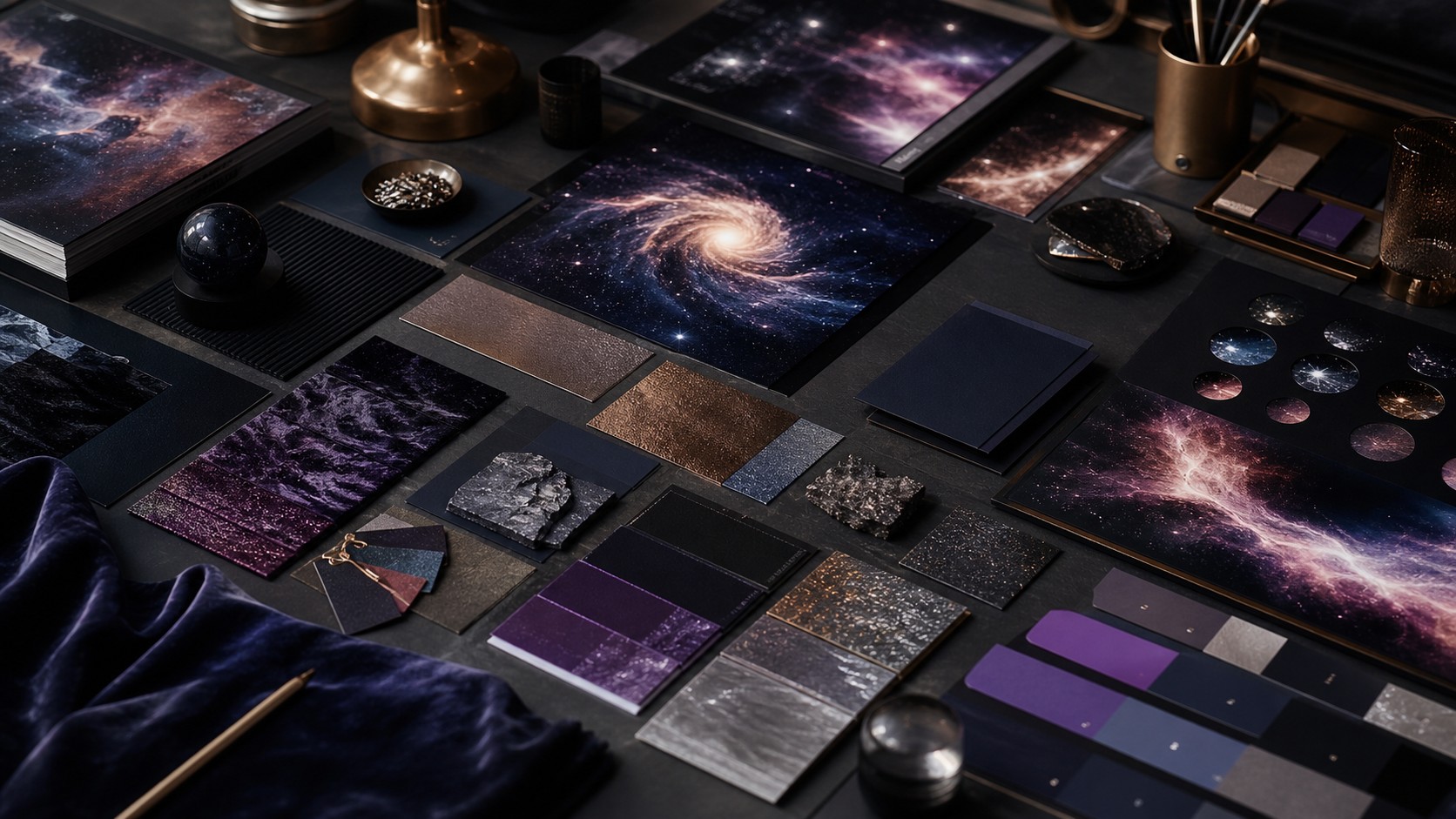
A common problem with galaxy themes is that they look like a digital wallpaper enlarged into a room. Texture solves this. A ribbed wall, velvet chair, wool rug, linen curtain, ceramic lamp, or stone tabletop brings the theme into the body. The room starts to feel touchable rather than projected.
Texture also helps with acoustics and warmth. A dark, glossy room can feel cold if every surface is hard. Soft seating, rugs, curtains, and upholstered panels make the space more comfortable and can improve sound, especially in media rooms or bedrooms.
The best textures do not need to be literal. A speckled surface can suggest stars. A ribbed panel can suggest movement. A smoky glass table can suggest depth. These quieter references often feel more realistic than obvious printed motifs.
Texture can also create visual scale. A fine speckled surface may read like distant stars, while a larger ribbed panel may feel architectural. Combining fine and broad textures gives the room more depth without adding extra objects.
Avoid Perfect Symmetry Everywhere
Space is not a perfectly mirrored pattern, so galaxy design often benefits from controlled irregularity. A star field can be denser in one area and quieter in another. A glowing wall can be balanced by a darker seating area. A cluster of round objects can feel orbital without being arranged like a diagram.
This does not mean the room should be messy. The strongest designs use asymmetry with intention. One side may carry a tall lamp and artwork, while the other side stays lower and darker. The room feels more alive because balance comes from weight and light, not from exact matching.
Keep Technology Hidden and Reliable
Galaxy themes often use technology: LEDs, projectors, dimmers, smart bulbs, controllers, and charging systems. These elements should disappear as much as possible. Visible wires, blinking adapters, and tangled remotes make the room feel less magical immediately.
Plan control zones. One switch might handle practical light, another might handle atmospheric glow, and another might handle special effects. If the room needs an instruction manual for a guest to use, the system is too complicated. Realism comes from ease as much as visual effect.
Reliability also matters. Choose lighting that can be serviced, cleaned, and adjusted. A broken star ceiling or unreliable LED strip can turn a polished theme into frustration. Good design anticipates ordinary maintenance.
Technology should also be quiet visually. Black cords on pale walls, bright adapters, and visible control boxes can ruin the illusion faster than an imperfect paint color. Concealment is part of the design, not an afterthought.
Edit Until the Depth Remains
The final edit should protect the illusion of distance. Remove small objects that flatten the room, cover too many surfaces, or repeat the same symbol. Keep the pieces that create foreground, glow, texture, scale, and practical comfort.
Stand at the entrance and look for the first three things the eye notices. Ideally, one should establish depth, one should establish glow, and one should establish comfort. If all three are novelty details, the design needs more grounding.
A realistic galaxy theme feels like an environment, not a collection of space objects. Build darkness, place light carefully, add touchable texture, and let empty space do some of the work. The result will feel deeper, calmer, and far more convincing.
Use Real Space References Carefully
Real astronomical imagery can be powerful, but it needs editing when brought into interiors or decor. Highly detailed star fields may become visual noise at large scale. Bright nebula colors may look artificial under warm room lighting. Choose references for atmosphere, contrast, and composition rather than scientific completeness.
A realistic galaxy theme does not require scientific literalness in every detail. It should borrow believable behavior: distant light, uneven density, darkness between bright points, and a sense of scale. The room can feel more convincing when it behaves like space rather than illustrating space exactly.
If a project includes educational or science-focused elements, separate accuracy from atmosphere. Let labels, diagrams, or learning materials handle the facts, while the room itself creates mood. That keeps the design both useful and visually refined.
The edit should include a comfort check. Sit in the main chair, lie on the bed, or stand where guests arrive and notice whether the room still feels good from a human position. A galaxy theme should impress from the doorway, but it should also feel comfortable from inside the scene.
Build a Night Mode and a Day Mode
A galaxy theme should have more than one setting. Night mode can use star effects, low lamps, and colored glow. Day mode should rely on paint, texture, art, furniture, and clean surfaces. If the room only works after dark, it will feel incomplete during normal use.
Think of night mode as the theatrical layer and day mode as the design foundation. The foundation needs good proportions, comfortable furniture, and materials with enough quality to stand on their own. The theatrical layer can then make the room special without carrying all the responsibility.
This two-mode approach also makes the theme easier to live with. People can enjoy a dramatic atmosphere when they want it, then return the room to a calmer state for work, sleep, or daily routines.