Creative Ways to Use Accent Lighting in Themed Spaces
Accent lighting is one of the most powerful yet underappreciated tools in themed design. While architectural layouts and surface materials establish the physical framework of a space, accent lighting defines how that framework is perceived, interpreted, and emotionally experienced. In themed environments—whether immersive attractions, branded interiors, hospitality venues, retail experiences, or residential concept spaces—accent lighting is not decorative filler. It is narrative infrastructure. When used creatively, it shapes attention, reinforces story beats, and guides emotional response with a precision that physical elements alone cannot achieve. Unlike ambient lighting, which establishes general visibility, or task lighting, which supports functional activity, accent lighting exists to communicate meaning. It highlights, conceals, dramatizes, and reveals. It can imply age, evoke place, suggest mood, or even simulate natural phenomena that would otherwise be impossible to reproduce indoors. In themed spaces especially, accent lighting becomes a form of visual language—one that speaks directly to the subconscious. This article explores creative, professional, and highly effective ways to use accent lighting in themed spaces, focusing on storytelling, spatial psychology, technical execution, and experiential depth. The goal is not simply to make spaces look interesting, but to make them feel intentional, immersive, and emotionally resonant.
A: Bright enough to notice, dim enough to support—not dominate—the scene.
A: Yes, but limit palettes to preserve thematic clarity.
A: Behind trims, props, ledges, and architectural details.
A: It is primarily experiential, enhancing mood and storytelling.
A: Almost always—control equals flexibility.
A: When the source becomes obvious or distracting.
A: Yes, subtle transitions add depth and realism.
A: Absolutely, especially for pathways, foliage, and structures.
A: Treating it as decoration instead of storytelling.
A: Early—integrating it during design yields the best results.
Accent Lighting as a Storytelling Tool
In themed environments, lighting is never neutral. Every highlight, shadow, and glow communicates context. Accent lighting can be used to establish narrative hierarchy, subtly informing guests what matters most in a space. By selectively illuminating certain elements while allowing others to fall into shadow, designers can guide visual flow the same way a director frames a scene.
A medieval tavern theme, for example, feels more authentic when accent lighting mimics the uneven warmth of firelight rather than evenly distributed overhead fixtures. Pools of light on wooden beams, textured walls, or handcrafted signage suggest history and craftsmanship, while darker recesses imply mystery and age. In contrast, a futuristic or sci-fi environment benefits from sharp, deliberate accent lines, luminous edges, and high-contrast highlights that imply precision, technology, and control.
Accent lighting can also be used to imply progression through a narrative. As guests move from one area to another, shifts in color temperature, intensity, and direction can signal changes in time, location, or emotional tone. This allows a space to tell a story without relying on signage, text, or explicit explanation.
Highlighting Thematic Anchors and Focal Elements
Every themed space has anchor points—objects, structures, or moments designed to carry the thematic weight of the environment. Accent lighting is essential for reinforcing these anchors. Without proper lighting emphasis, even the most detailed set piece can fade into visual noise. Creative accent lighting focuses not just on making focal elements visible, but on making them feel significant. This is achieved through contrast. A well-lit object surrounded by softer ambient light naturally commands attention. The sharper the contrast, the stronger the perceived importance.
In themed retail, this might mean accenting hero products with directional lighting that enhances texture and color while keeping surrounding shelving more subdued. In entertainment spaces, accent lighting can isolate sculptures, props, or architectural details that serve as narrative touchstones. In residential themed interiors, fireplaces, feature walls, or custom art installations often become emotional centers when accented correctly. The key is restraint. Overuse of accent lighting flattens its impact. Creative application means deciding what not to highlight as much as deciding what deserves attention.
Using Color to Evoke Emotion and Place
Color is one of the most emotionally direct tools in lighting design, and accent lighting allows it to be deployed with surgical precision. In themed spaces, color should rarely be applied uniformly. Instead, accent lighting introduces color selectively, reinforcing mood without overwhelming the environment.
Warm amber tones suggest comfort, nostalgia, and intimacy, making them ideal for rustic, vintage, or fantasy-themed spaces. Cool blues and cyans evoke calm, mystery, or technology, often used in underwater, space, or futuristic themes. Greens can imply nature, growth, or the uncanny, depending on saturation and intensity.
Creative designers often layer color subtly rather than relying on obvious washes. A stone wall accented with faint green undertones can suggest moss and age without literal decoration. A corridor with cool accent highlights and warm ambient fill can feel both dramatic and navigable. Color shifts can also be used dynamically, changing slowly over time to simulate natural cycles or emotional arcs. The most effective color-based accent lighting feels discovered rather than imposed. Guests may not consciously notice the color, but they feel its emotional influence.
Revealing Texture and Material Through Light
One of the most overlooked creative uses of accent lighting is texture revelation. Materials behave differently under light, and accent lighting allows designers to exploit those differences intentionally. Rough stone, carved wood, brushed metal, fabric, and aged plaster all respond uniquely to directional illumination.
By grazing light across surfaces at shallow angles, accent lighting can exaggerate texture, creating depth and shadow that adds realism and tactile richness. This technique is particularly powerful in themed environments that rely on authenticity or handcrafted aesthetics. It allows flat surfaces to feel dimensional and surfaces to appear more materially honest.
Conversely, smooth or reflective materials benefit from controlled highlights that emphasize precision and finish. In modern or futuristic themes, accent lighting often traces edges, seams, or contours, reinforcing a sense of engineered perfection. Texture-based accent lighting is subtle by nature, but its cumulative effect is profound. Spaces feel more real, more detailed, and more immersive—even when guests cannot articulate why.
Creating Depth, Mystery, and Visual Layers
Themed spaces thrive on depth. Flat, evenly lit environments feel artificial and uninspired, regardless of how detailed their physical construction may be. Accent lighting introduces visual layering, allowing designers to create foregrounds, midgrounds, and backgrounds within a single space. This is achieved by varying light intensity, color temperature, and focus distance. Brighter accents in the foreground draw attention, while softer, cooler, or more diffuse lighting in the background suggests distance and scale. Strategic shadow placement can imply unseen spaces beyond walls, doorways, or architectural features.
Mystery is a critical emotional component in many themed environments. Accent lighting that partially reveals elements while concealing others encourages curiosity and exploration. Guests are naturally drawn toward light, but they are equally intrigued by what remains just out of view. Effective depth lighting does not obscure navigation or safety. Instead, it balances clarity with intrigue, guiding movement while preserving atmosphere.
Integrating Accent Lighting Into Architecture
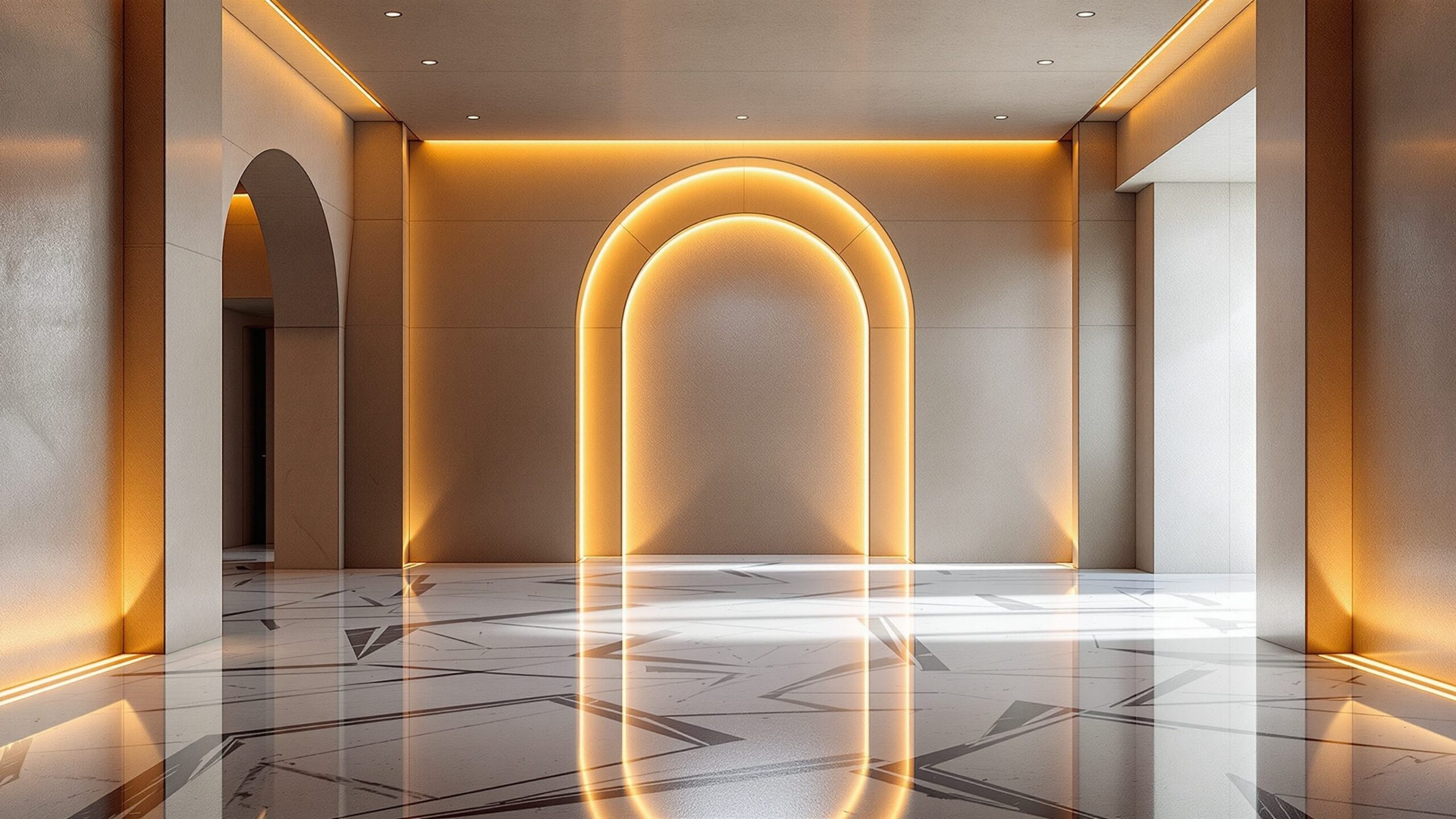
The most sophisticated accent lighting feels inseparable from the architecture itself. Rather than appearing as an added layer, it seems embedded within the structure. This integration enhances immersion by eliminating visible fixtures and reducing visual clutter. Recessed channels, hidden coves, integrated reveals, and concealed uplights allow accent lighting to emerge from walls, floors, and ceilings without drawing attention to its source. In themed environments, this technique preserves illusion. Guests see the effect, not the equipment.
Architectural integration also allows lighting to reinforce form. Curves, angles, arches, and transitions can be emphasized through light, making the space itself part of the narrative. In fantasy or historical themes, this may involve accentuating arches, columns, or relief details. In modern themes, it may involve tracing lines or planes with precision lighting. The result is a space that feels intentionally sculpted rather than simply decorated.
Dynamic Accent Lighting for Living Environments
Static lighting has its place, but dynamic accent lighting adds a layer of life to themed spaces. Subtle movement, shifts in intensity, or slow color transitions can simulate natural phenomena such as flickering firelight, passing clouds, underwater caustics, or the rhythm of a living environment. When used creatively, dynamic accent lighting enhances realism and emotional engagement without becoming distracting. The key is subtlety. Movements should be slow and organic, reinforcing atmosphere rather than drawing attention to the technology behind them.
In entertainment venues, dynamic lighting can respond to time of day, occupancy, or programmed sequences. In retail and hospitality, it can support brand storytelling or seasonal transitions. Even in residential themed spaces, gentle lighting changes can keep environments feeling fresh and emotionally responsive. Dynamic lighting works best when it supports a clear narrative purpose rather than existing for spectacle alone.
Guiding Movement and Experience Flow
Accent lighting is an effective tool for spatial navigation, especially in complex themed environments. By highlighting pathways, transitions, and thresholds, lighting guides guests intuitively without the need for signage. Brighter accents can draw visitors toward entrances, displays, or points of interest, while softer lighting indicates secondary areas or places of rest. Changes in lighting tone or intensity can signal transitions between themed zones, helping guests mentally reset as they move through a space.
This approach enhances both functionality and immersion. Guests feel guided rather than directed, maintaining the illusion of discovery while ensuring a comfortable and intuitive experience. Lighting-driven wayfinding is particularly valuable in immersive attractions, museums, and experiential retail environments where overt directional cues would break thematic continuity.
Accent Lighting as Emotional Pacing
Just as music uses tempo to shape emotional pacing, lighting can control the rhythm of a themed experience. Bright, energetic accent lighting creates excitement and momentum, while softer, dimmer lighting encourages calm and reflection. Creative designers use accent lighting to vary emotional intensity across a space. High-impact moments are supported by stronger contrast and focus, while transitional areas allow lighting to soften, giving guests psychological breathing room. This pacing prevents sensory fatigue and enhances memorability. Guests are more likely to remember moments that stand out against quieter backgrounds. Accent lighting helps define those moments without overwhelming the entire environment.
Avoiding Common Accent Lighting Mistakes
While accent lighting offers immense creative potential, misuse can undermine a themed space. Overlighting is one of the most common issues, where too many elements compete for attention, resulting in visual chaos. Accent lighting should be selective, not comprehensive. Another common mistake is relying on color alone to create interest. Without proper intensity control, direction, and contrast, colored accent lighting can feel flat or artificial. Similarly, visible fixtures that clash with the theme can break immersion instantly. Poorly balanced lighting can also distort materials, making them appear cheap or unnatural. Creative accent lighting requires coordination between lighting designers, architects, and fabricators to ensure materials and illumination work together rather than against each other.
The Future of Accent Lighting in Themed Design
As lighting technology continues to evolve, creative possibilities expand. Advances in LED miniaturization, wireless control, and programmable systems allow accent lighting to be more precise, adaptive, and integrated than ever before. Future themed spaces will increasingly use lighting as a responsive element, adapting to guest behavior, environmental conditions, and narrative progression in real time. Accent lighting will become less about static highlights and more about living systems that evolve with the experience.
Despite technological advances, the core principle remains unchanged. The most effective accent lighting serves the story. It supports emotion, enhances realism, and respects the psychology of perception. Technology is simply the means through which creative intent is realized.
Conclusion: Designing With Light, Not Just Fixtures
Creative accent lighting transforms themed spaces from visually impressive environments into emotionally compelling experiences. It shapes how guests perceive space, time, and meaning, often without them realizing it consciously. By using accent lighting to tell stories, highlight anchors, reveal texture, guide movement, and control emotional pacing, designers can elevate themed environments far beyond surface aesthetics. The goal is not brightness, color, or novelty, but coherence. Every beam, glow, and shadow should feel intentional. When accent lighting is treated as an integral design medium rather than a finishing touch, themed spaces gain depth, authenticity, and lasting impact. Light becomes part of the architecture, part of the narrative, and ultimately, part of the memory guests take with them long after they leave the space.